Vowel Cube Formant Chart

Diagram of articulatory cube of vowels projected onto a formant frequency chart.

Characteristics of vowels, such as those of the International Phonetic Alphabet, are typically plotted on a flat chart by their first and second formant frequencies or by qualities such as front, central, back, close, mid and open along the axes. The two dimensional charts with articulatory features as axes typically show the vowels in a diagram with vowels having one of the articulatory features in common being joined by a straight line, usually such that the space of vowels is bound by a quadrilateral or a roughly triangular shape. Sometimes the distinctions between the vowels are displayed in a three dimensional plot with the acoustic properties of the first, second, and third formants as axes or by articulatory features with the three axes as frontness, height, and roundness. While the plots in two dimensions by the first two formant frequencies are often compared to those in which height and frontness are the two axes, comparison of articulatory and acoustic plots in three dimensions are not so usual as a method of teaching phonetics.

On the Base Dozen Forum there is presented a portrayal of vowels in a three dimensional plot by articulatory features of high versus low, back versus front, and rounded versus unrounded as the three axes. The space of vowels is let be a cube with extreme vowels at its corners. For example, the most high and rounded back vowel is one of the corners, and the lowest and furthest back unrounded vowel is another corner. Another corner is allocated to the most high and front unrounded vowel. These are three of the standard cardinal vowels proposed by the phonetician Daniel Jones. In the three dimensional space that is here proposed, these three cardinal vowels form the vertices of an equilateral triangle in the cube. To the other corners are assigned vowels according to the resulting articulatory dimensions of the axes aligned with the edges of the cube. Apart from vowels at the corners of the cube, other vowels of intermediate qualities are plotted between the corners, either along the edges or on the faces of the cube. At the centre of the cube is a schwa.

To compare this cube of vowels by their articulatory features to their acoustic properties on a formant chart, the cube is transformed by rotational orientation and scaling before it is projected onto the planar formant chart. The result is that the positions of the projected vowels agree extraordinarily well to their positions by their measured formant frequencies. Using the outlines of the edges of the projected cube, it is possible to predict the effects of changes in articulation on the acoustic qualities of the vowel. This should make this proposal more useful for understanding what a vowel will sound like in relation to known vowels than an ordinary chart in which unrounded and rounded vowels having the same features in other respects are merely placed beside each other in pairs without indicating how their formants differ, although it is expected that rounding applied to front vowels or unrounding applied to back vowels will centre them acoustically.

Diagram of articulatory cube of vowels projected onto a formant frequency chart.

References:

https://dozenal.forumotion.com/t87-vowel-cube

On Democracy

In mediaeval history, governance of society was under a feudal system in which the majority of people were controlled by a minority of aristocrats. I remember thinking the people must have been cowardly or sheepish to pay tithes or a tenth of the income from their labour to overlords who had not earned it. Of course, it was the fear of being harmed by the force of weaponry and the law that cajoled people to comply with being exploited. Most of the tithes thus collected were used to disproportionately enrich the ruling class or fund expeditions of conflict. Expenses arising from such wars leading to oppressive higher taxes eventually resulted in revolt and overthrow of the aristocracy in the case of France for example.

Modern governments when taking up the airwaves are often proselytising about the superiority of their “democracy” to justify attacks on foreign dictatorships. While it may be true that a dictatorship may be a more barbaric form of governance than a democracy, the fact is that almost all modern countries do not have real democracy for their citizens. Democracy means that the people have the power to decide on all matters of public policy by a vote of majority. In contrast, in most modern countries, the people are only able to vote to delegate or divest their decision-making rights to representatives. Most of the time, representatives once elected do not act according to the wishes of the people who voted for them, or even according to their pre-election campaign mandates, because there is no mechanism to prevent those who receive power from using it for their own ends until their term has expired. Some politicians might start out with ideals to change the government for the better, but typically as they get older with success and form families for themselves they become more inclined to be interested in politics for the high salary. Once elected, politicians usually act without consulting the public because this makes them feel powerful, influential, and important.

It might be thought that the electorate have the choice to vote for candidates with the opposite policies, but in reality the voters have no choice over who ends up on the ballot sheet and often the only candidates with a chance of securing enough votes to be elected are from one of two parties that can simply alternate power after abusing it in the same way from one term to another. Sometimes the two main candidates do not differ substantially in their policies or characteristics so that there is not significant variety for the voter. An example of Hobson’s choice for a voter with anti-elitist sentiments could be for example the election of either candidate in the American presidential elections where both main party nominees had been members of the same elitist secret society. The American system is designed such that only those who have enormous financial resources are able to fund the election campaign, which inevitably means that elites will always retain power no matter which of their nominees is elected. There is a propensity for the elected to be beholden to the funders rather than the voters.

Another consequence of the expensive campaigning is that voters are influenced to make a decision based on the candidates’ charisma rather than manifesto. During election campaigns, posters of unflattering candidates can spoil the remaining scenery in the already metal, concrete, and asphalt urbanised landscape. To outsiders, the American elections appear to be an utterly hellish system, and yet they are the most arrogant in insisting that other nations conform to their version of “democracy”. It is not surprising that they would take that stance since this form of government is so easily funded, infiltrated, and manipulated by foreign agents. Many people could say that former dictatorships such as Iraq or Libya were better places to live before their dictators were overthrown.

To make matters worse, when the electorate is compelled to choose a person to vote for, there is no way to prevent conflicting policies from manifesting within the same candidate or nominee. For example, if a voter wants to vote for environmental preservation as well as moral conservativism but the only candidate with stated policies of environmental protection is perversely liberal, then the voter would have no choice to vote exclusively for all preferred policies.

Remedial Proposal: My suggestion to solve the problems noted above is to abolish all politicians entirely and restore decision-making on policy to the voting public. In essence, citizens would be able to vote for policies rather than politicians or for principles instead of presidents. The details for achieving this true form of democracy could differ, but I could offer some illustration. In each local area of a certain population size large and small enough to fit into a hall to be used for the purpose of assembly, at regular intervals they would convene to propose bills and vote. Many such local areas could be formed from parishes having churches or town halls already that would be suitable for the congregation. It could be defined in national legislation that the last Friday of every month, for example, could be guaranteed to be a day exempt from any form of work or employment to enable this day to be reserved or set aside for voting and other political decisions. Nobody would be allowed to work on that day from the morning to the evening, even in retail, hospitality, or entertainment, with exceptions perhaps of emergency responders, but few other essential services. Anybody would then be able to attend the local hall on that day. Attendance would not be compulsory. People could use the day off to go for some exercise in the park if they prefer. On the other hand, all those who are interested in being involved could contribute by voting or by proposing matters to be voted upon. Anyone unable to attend the hall because of being abroad or too infirm shall be deemed ineligible to vote, as necessary to prevent falsification of votes.

On these political days, when voters enter the hall, they would be given their voting token, which they would put into ballot boxes to indicate their decisions. The slots to the ballot boxes would be behind a screen so that only the voter would be able to see what his vote is. This is important to prevent interference on the voter by the pressures or intimidation of others in society. When the voter is voting, the display of his proof of identity would be demanded and his name would be ticked on a checklist to ensure that no one else impersonates him and to prevent him voting more than once. When all voting on that issue is complete, the numbers of tokens in each ballot box would be counted quickly for example by weighing or stacking them into shaped containers, which could be effective when the tokens are all of the same proportions and material. There would also be a check done to confirm that the number of tokens in the ballot boxes matches the number distributed at entry. It is important that executive voting on enacting issues be done without electronic devices to avoid interference, tampering, or election fraud. Notwithstanding that, voting and contributions on more preliminary matters and drafts could be done electronically, provided the final versions are voted on by physical token.

All matters on governance of local issues would be decided by majority vote of those present from the area. When an issue is being proposed for being voted upon, it must be put in typed writing on a standard form without any other promotional information such as photographic or artistic renditions of any person. For people who are unable to read, there would be a facility for the text to be converted to an audio speech simulation from a diverse range of synthetic computer voices, but it would be forbidden to read or broadcast the text of any proposal publically by any other voice, in order to prevent people being persuaded to vote one way or another by any personality.

To propose an issue to be voted upon, it would be written in a short title presented to all voters. If a majority of them decide it is a topic worth considering, then any voter may submit proposals for or amendments to exact wording. This could be done at an electronic stage. There would be a rule that only one topic or policy can be contained in the wording of each proposal so that there would be no conflict within it. A proposal with exact wording agreed upon by majority voting proceeds to the formation of a bill. The agreed wording approved by majority electronically must subsequently be approved by a majority of votes in token form to progress to publication. This must be printed and published for inspection in the hall. At least one month after the publication of the agreed wording, a vote is to be taken on whether it should be enacted. Each voter must be handed a hard copy of the written bill at the moment of voting on it. This hard copy can be shared and passed around if resources are limited. There would also be hard copies of the text at the altar and as a poster in the voting booth. It would be enacted locally if there is a majority of votes for it from that hall.

However, there would be rules nullifying the effect of local bills if they conflict with national legislation or are not within the sphere of local matters unless enacted on the national level. There would be laws on the national level to allow uniformity of conduct when travelling from one locality to another within the country. For example, laws on behaviour would be mainly at the national level to prevent travelers being surprised or caught out by unknown laws when transiting. A bill voted for by majority in a local hall that requires national approval would be submitted to a higher tier such as a county or province of halls. At the higher tiers, there could be further opportunity for amendment to the exact wording of the proposed bill. If a majority of halls in that higher tier also vote in favour of that bill, then it could pass to the national level where it would be enacted if approved by a majority of the halls throughout the country. Some issues affecting fundamental laws such as of a constitution would require a referendum whereby the question is voted upon directly by the people as individuals because it affects them individually and not their locality per se. Bills on spending and taxation would not be decided by referenda, but through the tiers of halls.

All appointments to public jobs would be decided by the citizens in the local hall if the job is a position acting only locally. If a job is to be involved at a higher tier or nationally, then the appointment must be approval at the appropriate level. No public job position appointment or hiring would be allowed unless voted upon by a majority at the relevant tier. Like the proposition of bills, any jobs required must be proposed starting at the local hall level and at an electronic stage to begin with. Once it is agreed by majority that a certain type of job is required, further contributions would be considered on the exact job description and requirements and remuneration for advertisement to applicants. Voters must agree by majority on all conditions such as knowledge, skills, or experience and whether they are desirable, necessary, or sufficient alone or in combination for being hired and these conditions must be included in the advertisement. At least one month after the publication of the advertisement, the final version of which must be agreed upon by token voting, and when an adequate number of applications have been received, shortlisted candidates must present their bodies in the hall before the assembly to prove that they are genuine and not virtual candidates and are of sound body or intellect for the role as the case may be. This session may include performance tests, requests for proof of identification, and other verifications. Voters list their choices scored in order of preference and these are added up to hire the most successful applicant. Transfer voting could apply.

At the appointment stage, a final approval has to be obtained by the courts which decide whether a background check is required for that type of job. This is to be decided by whether there has been a precedent from any sentence for any offence prohibiting any convict of that activity or if it is specified in national legislation. The courts must decide whether the type of work of the job requires a background check before accessing the records of the applicants in particular. The appointment decision for a particular applicant is to be influenced by whether any criminal conviction of that applicant included in its sentence a prohibition, whether enduring or not, on certain stated kinds of work. Otherwise, the appointment is not allowed to be influenced by records of offences. This is to be done for data protection reasons and to prevent minor offenses such as traffic offenses from influencing the employment if they have no relevance to the type of work.

If “representatives” are required for trade missions or diplomacy, these are to be treated as civil servants appointed in the usual manner outlined above. They are to have no executive negotiating authority, but may only gather and convey information between the exterior personnel and the interior citizens, who decide on every agreement or treaty by majority voting. All tendering processes are to be decided either by citizen voting or by suitably qualified civil servants appointed for that purpose.

Proposals for cancellation of any public job or indeed firing of any particular civil servant may be presented at the voting halls by any citizen, which can and should be done anonymously, and are ratified by majority at the relevant tier for that role.

This form of democracy that I propose is more similar to the original Greek form of democracy or of “direct democracy” in practice to some extent in a small number of countries such as Switzerland than the forms of politics of most modern countries are. The pre-existing instances of direct democracy demonstrate that this is an effective mode of politics, and that lesser forms of “democracy” involving election of representatives as politicians steal rights of autonomy from their citizens and can be little better than short term monarchies.
Logarithms of Primes in Bases

Properties of logarithms enable calculations to be conducted by simpler operations, provided the logarithms and antilogarithms are available for consultation from tables or by a mechanical slide rule or similar device if not by computation. A logarithm of a multiple of two quantities is the sum of their logarithms. This enables multiplication calculations to be reduced to addition. A logarithm of a fraction is the difference between the logarithms of its numerator and denominator, enabling division to be replaced by mere subtraction followed by conversion of the result to the power term by the antilogarithm or exponentiation. It follows from these rules that the logarithm of a composite whole number can be reduced to a sum of multiples of the logarithms of its prime factors, and indeed the logarithm of any rational number can be decomposed into addition and subtraction of multiples of the logarithms of the prime factors of the numerator and denominator of the fraction. Furthermore, logarithms can be used for calculating irrational numbers that result from algebraic operations on rational numbers. A rational number can be raised to any fractional power by applying a logarithm, which can then be manipulated by the rules of logarithms to provide the fraction multiplied by the logarithm of the rational number. For example, the rational number three to the power the fraction a half is the same as the irrational square root of three and can be calculated with the aid of logarithms by taking the logarithm of it to any base, resulting in half the logarithm of the prime number three to that base. That result is then converted from a logarithm to a power term by exponentiation to furnish the square root of three to an accuracy of the number of significant figures allowed by the logarithms and antilogarithms available.

While the rules of logarithms apply no matter what consistent positive real base they have, it is clear that logarithms would be especially useful if the base chosen were one such that the logarithms of the simplest prime numbers to that base were approximated peculiarly well by a limited number of significant figures of their logarithms. Unfortunately, logarithms are usually transcendental irrational numbers that cannot be exactly represented by terminating strings of numerals in positional notation. Nevertheless, sometimes the logarithm of a number such as a prime number can be approximated well enough to a few significant figures, which would make arithmetic with them involve fewer steps and be faster. For example, if the base of the logarithms is chosen to be close to a root of the prime number two whereby two is raised to the power of a unit fraction or reciprocal of a counting number, then raising that irrational base to the power of that counting number will result nearly in the prime number two with the consequence that the logarithm of two to that irrational root base will be nearly a whole number capable of being represented by a finite number of significant figures. The creation of such a root of two as a base is equivalent to a temperament of the musical octave into equal geometric steps, with the ratio between the frequencies of adjacent notes a step apart being the base of the logarithms. The task of finding a base of logarithms such that the logarithms of the smallest prime numbers are approximated very well by terminating numbers is hence equivalent to finding temperaments of the octave that align with the frequencies of the first prime numbers as harmonics.

A number of temperaments of the octave are already known to provide good coincidences with the first few harmonics. The most widespread is the equal temperament of the octave into twelve semitones, which corresponds well with the harmonics that are powers of the prime numbers two or three, and to lesser accuracy the prime number five. Other temperaments can approximate more of the small prime numbers. For example, temperament of the octave into six dozen equal step notes can provide good enough approximation to the first few smallest prime numbers two, three, five, seven, and eleven. Since the twelve semitones are a subset of these six dozen steps and six dozen is half the second power of twelve, temperament of the octave by a power of base twelve is particularly useful for music and would be good as a base of logarithms for mathematical calculations. While there is little wrong with temperament of the octave into six dozen steps in music, a slight annoyance could arise with this formulation of the base of logarithms mathematically because there are two bases involved: binary, the logarithm to the base of which gives the number of octaves, and dozenal for writing the logarithms in numerals and expressing the number of steps within the octaves, but just one base for the number of different numerals and for the base of the logarithms and all computation would rather be desired. Is there a way to have the same base for the base of the logarithms and for the number of different digits by which the logarithms are notated? The answer is almost.

If the problem is approached initially by finding base B such that B^(1/B) is nearly the frequency ratio of the step in the octave desired, then the same base can be used as the base of the logarithms and as the number of different numerals for notating numbers such that the logarithms will tell the number of those steps, but the logarithms will not necessarily round well at the octaves to powers or whole number multiples of that base B. It so happens that the temperament to six dozens steps per octave is approximated when the base B is the square or second power of twenty-six. A base for the logarithms can be constructed by sectioning the square of twenty-six into twenty-six steps geometrically. The logarithms of the smallest prime numbers two, three, and five to that step as base, which is equivalent to half the logarithms to the base twenty-six, will be particularly accurate to two significant figures when written in base twenty-six. The logarithm of the prime number seven to this base is not as accurate at just two significant figures. Thus, computations using logarithms of numbers containing the first three prime numbers would be unusually convenient in base twenty-six, which could be called base two dozen plus two or twenzy-two in another form of dozenal parlance. There are as many upper case letters in the modern English variety of the Roman alphabet to use as symbols for the numerals for this base.

More accurate results for the logarithms of also the next prime numbers seven and eleven can be had to two significant figures by base thrice eleven, using a third of the logarithm to that base. There are said to be as many runes in the English futhorc as the number of different numerals required for this base thrice eleven. However, apart from such a base being an odd one to use for general purposes in society, like base twenty-six it would not round to whole multiples for the number of steps at the octaves.

Is there a way to allow the numbers of temperament steps at the octaves to be round multiples of the base? This is possible if the step size for the base of the logarithms can be defined in terms of powers of the number of equal temperament steps per octave. To make that number of steps a convenient base to use, it is made to be a power of twelve, either twelve itself or its square. For a step near two to the power of a square twelfth, the square of thrice thirteen is close to the base in B^(1/B) required for the logarithms, but the logarithm of two is not as accurate to two significant figures and the notation would have to be in base twelve for the numbers of steps at the octaves to be rounded.

More conveniently, the base of the logarithms for the semitone is given nearly by the cubic dozenth root of twelve to the power of forty. When such logarithms are written in base twelve, there are few significant figures to a good degree of accuracy for the first few prime numbers. The prime number seven requires more significant figures for a not worse level of accuracy, but they are not too many to be useful in approximate calculations. These logarithms give approximations for the numbers of semitones for the harmonics, which are easy to remember when musical theory is understood. These logarithms are defined in terms of powers only of the base twelve and can be reduced to simple arithmetic using the base twelve logarithms.

It should be mentioned that the fortieth root of ten also nearly gives the semitone step, but expressed that way the base of the logarithms and the base of numeration to allow rounded numbers of semitones at the octaves for this to be useful in conjunction with musical theory are not the same. The common decimal logarithms of the smallest prime numbers two, three, and five are accurate enough to two significant figures if multiplied by forty or four. A thousand to the power of a hundredth partitions the octave into ten equal steps. Not many useful bases B have that property of having whole number values of n and m to make B^(n/B^m) partition the octave into nearly B steps. Binary bases, decimal, and dozenal do. The dozenal option that I have described has the extra benefits of giving accurate values for the logarithms of the first few prime numbers by a small number of significant figures and agreeing well with the most normal musical temperament.

Invention of Musical Wind Instruments

Prior Art: Musical wind instruments are of various kinds functioning on slightly different principles. They all involve vibration of air in a cavity and differ in the shape and material of the cavity as well as the method by which the air is set in motion.

The earliest type of wind musical instrument preserved is probably the flute, which is a hollow mainly cylindrical tube with holes along the length that can be blocked by the fingers. With some exceptions, opening the holes shortens the column of air vibrating and increases the pitch or frequency of the note. The air is set vibrating by blowing against an edge at one end of the flute, either longitudinally or transversely. In whistles and recorders blown longitudinally, the mouth blows air across a fipple. The oldest flutes that survived were made of bone, but they could also be made from wood or cane. Folk or traditional flutes are made of wood, while the modern concert flute is made of metal. In pan pipes, there are no finger holes but rather a different length of tube for each note.

In woodwind and certain pipe instruments, the air is set vibrating at the mouthpiece by a thin flat reed, either double as in shawms, oboes and bassoons or single as in clarinets. The modern saxophone has a single reed mouthpiece like a clarinet but is made of metal and has a conical interior. These instruments change pitch by holes along the length. Organ pipes, typically made of metal, also use a reed, but tend to be of fixed length for each note.

Another ancient type of wind musical instrument is a horn or trumpet. The horn has a conical rather than cylindrical cavity. At first, these would have developed from animal horns, before being fashioned of metal, leading to modern brass instruments. The air is set vibrating in them by the buzzing of the lips on a cup mouthpiece. The pitch is lowered by increasing the length of the tube. In horns, the extra length is attached as crooks. In modern horns and trumpets, the crooks are fixed to the instrument and the air flow through them is regulated by valves and pressing lever or piston keys with the fingers. In the trombone the lengthening is achieved by sliding an extra length of tubing. Trumpets and trombones have a more cylindrical or less conical shape than horns and tubas. Trumpets are amongst the loudest of orchestral instruments. Mutes of various kinds can be inserted onto the bell end of brass instruments to muffle the tone to some degree. The pitch can also be altered to some extent by such mutes or stopping the bell end with the hand in the case of the horn.

The ocarina is a very ancient instrument that is a cavity of air of any shape enclosed within a vessel of any material, but often clay, and functions as a Helmholtz resonator. The air is set vibrating in a way similar to that in a flute or by a fipple. Pitch is altered by the opening or closing of holes by the fingers. It is the size of the holes that determines how much they alter the pitch, while their positioning is irrelevant to the pitch. Opening smaller holes increases the pitch less than opening larger holes.

My Proposal: For design of a wind instrument to be as simple as possible in its construction yet capable of producing all semitones in its range of discrete pitches, I propose first creating a chamber like an ocarina in the shape of a horn stoppered at the bell end by a detachable stopping mute. The stopping mute shortens the effective vibrating length of the waveform and raises the pitch by about a semitone. To overcome the decreased projection of the sound as a result of the stopping mute, holes drilled into the material along the length of the resonator body are to be opened by the action of the fingers to allow the air to escape. The diameters of the holes are such as to increase the pitch in intervals when opened. The smallest hole is to be such as to increase the pitch by one semitone; the second smallest hole is to alter the pitch by a whole tone or two semitones; the third smallest hole is to increase the pitch by a minor third or three semitones when opened; the fourth hole is to increase the pitch by a perfect fourth or five semitones; and the fifth hole is to increase the pitch by an octave when opened as an octave or descant key. The choice of intervals for the holes is to emulate the interval changes resulting from the customary keys on a brass instrument. Thus, the smallest hole of this design is to mimic the middle or second key of a horn which when depressed by the middle finger lowers the pitch by one semitone; the second smallest hole mimics the first key that when pressed by the forefinger lowers the pitch by one whole tone; the third smallest hole when pressed over by the finger resembles the third key of a modern brass wind instrument in lowering the pitch by a minor third. The fourth smallest hole resembles the mechanism of changing between the F and B-flat modes of a modern double horn in the interval by which it modifies the pitch, especially in those models in which pressing a thumb key opens the air flow to the extra length of tubing for the F-horn compared to the B-flat horn. The octave or descant hole mimics the operation of a descant horn in a modern triple horn. Thus, the design of the five holes serves an educational role in how the notes are to be keyed in brass instruments. By the combinations of fingering over these five holes, all of the semitones in a range of two octaves less a semitone may be played, which is a useful range for a melodic musical instrument. The air is set in motion at the mouthpiece end, which is to be detachable to allow adaptable insertion of the various kinds of mouthpiece. This much describes the stoppered mode of the instrument.

When the bell stopper is removed, the instrument behaves like a conventional unmuted wind instrument in regard to the quality of tone when all holes are still closed. However, the presence of opened holes along the length of the tube can affect the quality of the tone produced, similarly to wind instruments such as flutes that have finger holes.

Since the unstoppered instrument no longer acts as a Helmholtz resonator, the positions of the holes along the length of the instrument must be chosen so as to match the intervals by which they alter the pitch of notes. The effective length of vibrating air in the column is inversely proportional to the frequency. Thus, to increase the pitch by a semitone, the length of vibrating air ought to be shorter from the original length by a factor of the reciprocal of the twelfth root of two. Hence, the semitone hole should be positioned a twelfth root of the length of the column away from its original end. Similarly, the whole tone hole should be positioned from the bell end by a factor of the sixth root of two of the original effective vibrational length. The finger hole for modifying the pitch of notes by a minor third should be positioned at a distance of a quartic or fourth root of two of the original effective vibrational length from its bell end. The finger hole for the interval of the perfect fourth should be at three quarters of the original length of the tube. The octave or descant hole should be at half the length of the tube.

The coiling of the instrument may allow the finger holes to be reached ergonomically by the fingers of one hand despite their positions along the length of the tube. Unfortunately, in a conventional keyed brass instrument, the third key that alters the pitch by a larger interval than the first and second keys is positioned closer to the bell than the first two keys, whereas in the proposed design it ought to be upstream of the first two keys. The reason for this discrepancy historically may be that the first two keys are more frequently used and consequently have the more dexterous forefinger and middle fingers assigned to them.

In order for combinations of open holes to be effective in producing predictable interval changes to pitches as simple combinations of their individual frequencies, the diameters of the finger holes must be small enough to enable the waveform to bypass an upstream open hole and be affected in pitch to the right amount by a closed downstream hole. A similar effect can be seen for example in the flute. I devise notation whereby an open hole can be denoted by a circle or the symbol 0, a closed hole by a vertical line or the symbol 1 representing the finger, and a half open hole by a vertical line in a circle, or the symbol Φ. The left hand fingering is to be preceded by the abbreviation of the initials L.H., while the right hand fingers are to be denoted by the preceding abbreviation R.H. Thus, on a flute constructed in the pitch of C, the note G having the fingering L.H. 1111 R.H. 0001 may be altered to a semitone lower by closing holes downstream of the uppermost open one by the fingering L.H. 1111 R.H. 0111 or may be lowered by a whole tone to the note F with the fingering L.H. 1111 R.H. 1001 by the closing of the highest open hole. In the instrument the design of which I propose, the closing of the two holes merged and positioned as though they were a single hole in the flute to lower by a semitone is analogous to the closing of a single semitone hole in my design. Similarly, the lowering of the pitch by a single tone by depressing a finger hole in the flute is analogous to lowering by a whole tone in my proposal also by closing one hole by a finger.

In order for this mechanism to be as effective as possible without reducing the sonorous quality of the tone of notes produced, the holes should neither be too far apart not too large. For example, in the case of the octave or descant hole, the diameter of the hole must be small in the unstoppered mode of operation in order to allow the simple combination of its interval with those intervals of the other holes, whereas in the Helmholtz resonator mode, the octave hole must be the largest of the holes mentioned. To overcome this conflict, at the position of the octave hole, there may be two holes side by side, one smaller and the other larger, which when combined would have the correct large area for the Helmholtz resonator, while only the smaller of these two holes would be opened to access the descant in the unstoppered instrument, by a sideways motion of the finger or thumb as the case may be.

In a brass wind instrument without finger holes open to the atmosphere, harmonics above the fundamental for the length of the tube may be accessed by increasing the tension of the buzzing lips, and a great dynamic range is accessible through changes in the force of breath. In instruments such as flutes with finger holes open to the atmosphere on the other hand, changes in force of breath may negate their combined effect and there is an increased risk of the pitch jumping between registers with changes in amplitude intensity or volume because the register is controlled more by the speed of the breath than tension of the lips compared to brass instruments. A result expected for the proposed design therefore would be decreased accessibility of the loudest dynamics at lower registers compared to conventional brass instruments. However, this risk may be overcome to some extent in performance by plugging the finger holes of the larger descant octave and perfect fourth intervals when a greater number of harmonics are being accessed through tension of the lips such that fewer keys would be required when the bell is not stoppered. In conventional brass instruments, only three keys are necessary for accessing every semitone note in the entire range of the instrument. It would only be for playing the Helmholtz resonator bell stoppered mode that availability of opening of larger holes for the bigger intervals of the octave and perfect fourth would be required due to the fewer harmonics achievable.

The need for the holes to be closed by the fingers limits the size of the instrument and therefore prevents its fundamental pitch being too low. In conventional brass instruments with cup mouthpieces, the higher harmonics around the fourth power of two are easier to play by requiring less tension from the lips when the fundamental pitch of the instrument is lower. In smaller instruments, there is more reliance on the lower harmonics and keys to achieve the different notes. A smaller instrument of the proposed design could nevertheless reach higher notes than conventional brass instruments of the same size because of the opening of the hole to raise pitch rather than the mechanism of keys to crooks that lower the pitch.

In summary, my proposed invention offers advantages of a simpler construction without complicating moveable key mechanisms and a smaller size to achieve a high range in comparison to modern brass wind instruments.

I call my invention an ocorn or occorn. I also considered okhorn, but according to a trademark database search, apparently there is already that word in a trademark.

Dozenal Numeral Ten

I have designed a glyph for the numeral ten to be used in base twelve numeration. Various characters have been used historically for the digit ten in base twelve numbers. One of the earliest used by a dozenal society is the Pitman turned digit two, based on the initial letter t of the word ten. Various conventions have been tried for the letter to be used for the numeral ten. One is the letter A, part of the system of transdecimal extensions to the Indo-Arabic digits used for hexadecimal numbers and called IBM computerese by dozenists. This scheme is considered to emphasise base ten as the ace of bases too much for dozenists by the first letter of the alphabet starting on ten. Another option is the letter J because it is the tenth letter of the alphabet. Yet another proposal is the letter d standing for dec or dek meaning ten. In recent years, some dozenists have begun annotating that numbers are to be read as written in base twelve by suffixing them with a subscript letter of the alphabet. This means that in order for dozenal numbers to remain distinct from decimal numbers, the decimal numbers need to be annotated with a literal suffix. However, these are not standard practice in formal mathematical literature, where bases are annotated when distinction between bases is necessary by digits in decimal format rather than by letters of the alphabet. The most popular numeral for ten among dozenists currently is the Pitman turned two ever since it entered Unicode. As such, this symbol can be interpreted as a numeral and not just a letter, bringing it into line with conventional mathematics.

My design is based on all of these literal characters for ten. Firstly, it is derived from the Pitman turned two by closing the curl in order for the character to have a distinct seven-segment modular element display. This fixed one of the disadvantages of the original unmodified Pitman turned two whereby it looked too similar to other numbers or characters, including the numbers two and seven, and the letter zed. However, closing the loop resulted in a figure that looked too similar to a style of the digit three having a horizontal top bar. To improve this issue, the next stage was to make the numeral look more like the tenth letter J of the alphabet while still resembling the Pitman turned two by a horizontal top bar and closing curve with the end meeting onto the partial stem. The present latest version modifies this further by making the join of the closed curve attach to the partial stem tangentially upwards. The resulting glyph can be written by hand quickly and effortlessly without lifting the implement from the page until the digit is complete. Additional bonuses are that it conveys a lower case letter d and double story letter a. Thus, my design proposal solves most of the conflicting usages of different letters for the digit ten by merging them all into one character. This character remains distinct enough from other alphanumeric symbols and glyphs to retain its unique meaning dedicated to the numeral ten for numeration using base twelve.

Further benefits of my design are that it has cues of the digits five and two that are the prime factors producing the number ten. As well as the turned digit two derived from the Pitman turned two, it contains a reversed digit five. Another effect is that a horizontal line and a closed curve suggest the numerals one and zero of the number ten in decimal format joined together and written vertically. This may increase subliminal identification in a transition from decimal to dozenal notation.

In summary, my design for the numeral ten for dozenal numbers satisfies the following inclusively:

  • The initial letter t of the word ten from the Pitman turned two;
  • The initial letter d of the morpheme dec or dek for ten;
  • The tenth letter J of the alphabet;
  • The letter a in lower case double story style from IBM “computerese”, often used for the numeral ten in hexadecimal numbers;
  • The decimal digits 1 and 0 forming the number ten in decimal format joined together and written vertically one under the other; and
  • The digits for the prime numbers two and five of which the number ten is composed as the product.

Disk Drive Frequencies

This morning in the newspaper Irish Independent on Saturday, I read the article entitled “Laptops can be crashed by Janet Jackson song, Microsoft says”, by Josie Ensor on pages 24 to 25. This prompted me to recount an experience I had and wrote about some years ago:

“Monday 8th March 2010. Yesterday I was using the compact disk […] that I bought on 10th January 2009. On my computer, I used the […] software on the disc to record and analyse […] in order to measure the frequencies […]. Almost immediately after I recorded […] there was an error on my computer and I was forced to close the software and I restarted the computer. Then I recorded the set […] instead. When I listened to the recording through earphones I noticed a descending glissando note […]. When I analysed the spectrogram of the recording, I saw what appeared to be like a formant of linearly decreasing frequency […]. By choosing spectrogram controls in the software program and setting the contrast at a maximum and brightness quite low and increasing the “Analysis window length” to a maximum I was able to see what appeared to be overtones or higher formants of the first glissando note. The other frequencies also decreased in pitch linearly with respect to time but with larger slope of the oblique lines as the formant increased in pitch. I noted particular frequencies of the formants at the arbitrary time 1.161 seconds from after the beginning of the recording. At that time in the recording, the fundamental frequency of the glissando note was 1549 Hertz; the frequency of the second formant or first overtone was 2268 Hertz; the third was 3139 Hertz; the fourth was 3888 Hertz; the fifth was 4597 Hertz; and the sixth was 5367 Hertz. I examined the ratios of these frequencies and found that they were as ratios of simple whole numbers. Setting the frequency of the first formant or fundamental frequency as one unit, the frequencies of the notes or formants are: f1 = 1; f2 = 3/2; f3 = 2; f4 = 5/2; and f6 = 7/2. From these values, where f_n = (n + 1)/2, it can be seen that the sequence of the frequencies forms an arithmetic sequence. Since I had noted these simple rational frequencies at an arbitrary time, I reasoned that the ratios would be maintained at all times during the glissando. I took more data points of the frequencies at different times and plotted the results in the software […] to determine the equation of the fundamental frequency trendline. I found the linear regression equation Frequency (in Hertz) = -1382.5t + 3134.7 where t is the time in seconds from the beginning of the recording and the frequency is that of the fundamental formant. I plotted the trend lines for the other formants by multiplying the above equation by the ratio of that formant frequency to the fundamental frequency and superimposed this graph upon the picture of the spectrogram. I found a better fit to the upper formants by changing the intercept by translation from 3134.7 to 3157 without changing the slope very much from -1382.5 to -1383. The graph according to the equations fit the spectrogram perfectly. I do not know what the source of the glissando note was, although since I was making the recording while running the […] software directly from the compact disc drive of my computer, the source may have been the disc drive spinning.”

I then went on to speculate about the source of the observed ratios of the overtones, comparing them to musical intervals. I continued:

“Thus, if the frequencies that were produced simultaneously were of similar intensities, which they were not, then the chord produced would be a major chord in root position or uninverted, with the fundamental frequency as the root and base of the chord.”

I then went on to eliminate various types of sources of sound:

“[…] a vibrating string is supposed to produce overtones at whole number ratios to the fundamental frequency, […] about overtones that are produced in cylindrical pipes, both open and closed at one end, […] in a pipe that is open at both ends, […]. Since the frequency of a wave is inversely proportional to its wavelength by the velocity or speed of propagation of the wave through the medium as the constant of proportionality, […]. Thus, the ratios of harmonics produced by a pipe that is open at both ends would be the same as for those produced by a vibrating string. In contrast, for a pipe closed at one end, […]. Thus, the ratio of the nth harmonic frequency to the frequency of the first harmonic in a pipe that is closed at one end is 2n-1. These ratios increase arithmetically as odd whole numbers rather than half integer numbers, therefore the pipe closed at one end could not be the type of source of the glissando note that I recorded yesterday. The source could not be a vibrating string or pipe that is open at both ends either, since in both of those sources the ratios of harmonics to the frequency of the fundamental frequency increase arithmetically by a difference of whole numbers rather than half integer numbers, unless what I assumed to be the fundamental frequency of the glissando note is not really the fundamental note. This frequency was by far the most intense of the formants of the glissando note. However, the fundamental frequency is not necessarily the most intense harmonic. I have read, for example, that in the clarinet the note that is heard to be the one intended and played by the instrumentalist is a higher harmonic than the fundamental frequency of the first harmonic. However, even if the fundamental frequency is not the most intense harmonic of a composite note, we would still expect the fundamental frequency to appear with some intensity comparable to the higher harmonics. On the spectrogram of the glissando note, I could not find any evidence of a formant or harmonic below the one that I attributed to be the fundamental frequency. I plotted an oblique line of a formant with one arithmetic sequence frequency difference below the attributed fundamental so as to show where the possible expected hypothetical alternative fundamental frequency harmonic could be that could allow the glissando note to have been produced by a source like a vibrating string or an open pipe. Since there were no signals along the expected line for a lower fundamental frequency, either there is no lower harmonic of the glissando note, or for some strange reason the real fundamental frequency or first harmonic was not produced or is virtual.”

I then argued to eliminate causes for the glissando, debating speed of propagation, energy of the wave, temperature and cooling, density, and pressure of the medium, the action of pistons on the volume of cylindrical pipes and the ratios of frequencies in compartments closed at all ends, and changes in the mass or temperature by mixing of air by an air pump. Having eliminated these, I proceeding towards a conclusion:

“Tuesday 9th March 2010. […] The remaining possibility could be a change in the energy of the source of the wave, by change in the energy of vibration of a tremulous source. I think that the most likely explanation for the glissando would be a decrease of the angular speed of some rotor or wheel at a constant rate, until being stopped at the minimum speed by application of a brake, such that the frequency did not appear to reach zero. I think that the most likely wheel or rotor to be the source was a disc drive of the computer, especially the compact disc or digital video drive. Another less likely possibility is the fan of the computer that is used for cooling, as this would revolve and is not always turned on. […] I do not know what pattern of ratios or sort of overtones that [sic] a spinning disc could produce. […] it might be possible for a spinning disk to have fractional revolutions that produce overtones. […] I think that a more likely explanation would be that the disk wobbles or precesses at different frequencies to its frequency of revolution.”

I next debated precession, resonance, and coupling.

“Thursday 11th March 2010. […] Half-integer ratios between frequencies could be caused by resonance or by coupling. […] a spinning disk can have any frequency because it can rotate at any speed, and this explains how the glissando note could have arisen.”

Next, I described tidal coupling of planetary periods.

“Friday 12th March 2010. […] Perhaps then analogously, there could be coupling between different periods of precession or spin in a single rotating object, such as a disk. This coupling would give rise to fixed simple ratios of frequencies of the overtones. If the fundamental frequency were also fixed, then all the frequencies would be quantised. […]”

The arguments spanned some pages and were longer and more detailed than I would reproduce in full here. Later, I noted the following:

“Sunday 4th July 2010. Sometime after Saturday 13th March 2010 I looked at a book called “Genius, Richard Feynman and modern physics”, by author James Gleick because I wanted to read about the ancient scripts or writing system […]. I noticed the following which may be of relevance to what I wrote about between Monday 8th March 2010 and Saturday 13th March 2010: “A few days later he was eating in the student cafeteria when someone tossed a dinner plate into the air — a Cornell cafeteria plate with the university seal imprinted on one rim — and in the instant of its flight he experienced what he long afterward considered an epiphany. As the plate spun, it wobbled. Because of the insignia he could see that the spin and wobble were not quite in synchrony. Yet just in that instant it seemed to him — or was it his physicist’s intuition? — that the two rotations were related. […] he tried to work the problem out on paper. It was surprisingly complicated, but he used a Lagrangian, least-action approach and found a two-to-one ratio in the relationship of wobble and spin. […]” […]”

Flag for a United Ireland

On the front page of the Business Post of November 28th to 29th 2021, the main headline article was on the results of a survey on what proportion of people would be willing to admit some changes such as to the national flag or anthem in order to accommodate a united Ireland. The question of the flag seemed to me to be an unexpected one. The Irish tricolour flag already is supposed to represent a united Ireland. It was created before the partition of Ireland into the Republic and Northern Ireland. The colours of the flag already include representation of both the predominantly Catholic people of the Republic of Ireland by green and the Protestant majority at the time in Northern Ireland by orange. The white represents peace between these two groups. Does this not represent the outcome that is sought through a united Ireland?

Any problem then with the Irish tricolour flag for a united Ireland does not arise from any lack of appropriateness in its intention for fulfilling that purpose of unity but rather because there are some who see the Irish tricolour flag as a representation of separation of the whole of Ireland from the United Kingdom. In essence, the Tricolour does not seem British enough to Ulster Unionists. The tricolour carries the idea of revolution on the model of the French, appealing to Europe and the notion of a secular state the functions of which are inclusive of freedom of belief but separated from religious control. In the designing principles of the Irish tricolour or the adoption of a national flag by the Irish state, there was probably a motive to avoid an emblem having an overly religious connotation. Instead, the chosen tricolour is based solely on a simple geometrical combination of contrasting colours. For the Loyalists of Ulster on the other hand, there is preferred allegiance to the British crown, which may have its legitimacy conceived as proceeding from the divine right of monarchs. The emblems of the Unionists may for this reason be more likely to allude to religious symbols such as the Christian cross, to be found in the flags of nations in the United Kingdom and others like those of the Northwestern European Scandinavian neighbours. If a new flag is to be designed for a united Ireland to the satisfaction of Ulster Unionists, a model on a cross may be considered.

While Northern Ireland lacks an official national flag different from the Union Jack, there have been flags used for Northern Ireland alongside those of England, Scotland and Wales. The red saltire on a white background has long been used to represent Ireland. Despite being called the Cross of Saint Patrick, the patron saint of Ireland, it is derived from the heraldry that now belongs to the Duke of Leinster, the premier peer of Ireland. It entered the Union Jack where it represented Ireland, and now Northern Ireland. Irish institutions, such as universities in Ireland, have been using this heraldry in their insignia.

Another flag used for Northern Ireland is the Ulster Banner, which has a red cross on a white field. The red cross on a yellow field is contained in the traditional heraldry derived from the shield of Burgh for the Province of Ulster, not quite the same as Northern Ireland. Both of these flags contain the hand of Ulster emblem.

What we are contemplating here is the design of a new flag for a united Ireland, appealing to all, not a new flag for Northern Ireland. When thinking of a flag for Ireland, I first considered what the simplest available heraldry would be. The flag should be as simple as possible, with two or three colours only and no complicated drawings or emblems. As the colour most associated with Ireland is green, this colour should appear prominently. The heraldric pattern in line with Northwestern European nations would be a cross. A green cross on a white field or a green field with either a white or yellow cross seem to be the simplest approaches. The white cross on a green field in a flag for an independent Ireland by the United Irishmen appeared historically, so there is a precedent here. A yellow cross would be a simplification of an orange cross in a white cross. A yellow emblem on a green field appears in the flag of the province of Leinster and the Confederacy of Ireland, so these two colours are quite well associated with Ireland. However, these proposals seem inordinately suggestive of the Republic of Ireland and Catholicism only.

It would seem better therefore to include an orange cross or saltire of some kind to represent the inclusion of Ulster. The saltire because of the Cross of Saint Patrick seems a more fitting choice than a erect cross associated with England. A saltire is also on the flag of Scotland, where a Gaelic language is spoken too. Some have suggested a Celtic cross, but I think the Celtic cross would not represent inclusion of Ulster as well as the saltire would. A red saltire does not seem Irish enough to someone from the Republic of Ireland. Therefore, its colour ought to be changed from red to orange in emulation of the Irish tricolour flag.

The saltire can be modified in shape to a cross of Saint Brigid, which is a symbol heavily connected to Ireland, and probably more characteristically and recognisably Irish than a saltire. The cross of Brigid also happens to resemble the way the cross of Patrick is counterchanged in the Union Jack, so there is the added benefit of this appeasing Unionists. The orange figure must be surrounded by either white fimbriation or a white field, as that is the only available colour of traditional heraldry and suitable for a flag producing a sufficient contrast against orange. To have a green field or background, the contrasting white may intervene between the hues as a saltire.

Here is a depiction of this solution for the flag of a United Free State of the Republic and Northern Ireland:

After designing this flag, I searched Google with the terms “Brigid cross flag” and found that a similar concept had been proposed before, just ten months ago, of which I was previously unaware. In my opinion, the juxtaposition of green and orange there without intervening white fimbriation created an ugly effect. The similarity of the proposals shows how readily an orange cross of Brigid aligned with a saltire is likely to be thought of as representing a unification of the cultures of the Republic and Northern Ireland.

References

https://en.wikipedia.org/wiki/List_of_flags_used_in_Northern_Ireland

https://en.wikipedia.org/wiki/List_of_flags_of_Ireland

https://www.independent.ie/opinion/analysis/rethinking-our-national-emblem-what-could-a-united-ireland-flag-look-like-40395785.html

Dozenal Forum

There is a certain dozenal forum that currently has forty-three topics and 151 posts.

Posts include the topic of dozenal directions from Monday 21st September 2020 last year, where the main author on that forum proposed a system of dozenal compass directions whereby directions that are a twelfth of a turn from a cardinal direction are indicated by the word “of” between the names of two adjacent cardinal directions, with the direction after the word “of” being the angularly nearer of the cardinal directions. The abbreviation proposed was “XoY”, where X and Y are the initials of the cardinal directions. The system was extended to indication of quarter twelfths of a turn and preserves by incorporation the existing conventional scheme of binary divisions in compass directions.

Another topic in the forum is a proposal for a dozenal metrological system that preserves as much as possible existing units of measurement of the decimal metric international system reframed dozenally. The system allows existing decimal metric measurements and their units to be more easily converted mentally without the aid of calculational devices to dozenal than to any other dozenal system because it is so constructed that the conversions require only shifting decimal points or dozenal fractional points, apart from the conversion of numbers from base ten to base twelve. The most recent post under this topic was on Friday 12th February 2021 this year. The topic was started in the forum on Sunday 15th September 2019, but contains principles which were conceived and published earlier, for example the unit of time and the consequent unit of length leading to area and volume derived from it were communicated on the DozensOnline forum on Saturday 21st January 2017, and stated to have been conceived the previous year and can be read at the webpage address https://www.tapatalk.com/groups/dozensonline/all-your-base-are-belong-to-us-t1615.html#p40005757. The unit of mass was mentioned on Friday 28th April 2017 at https://www.tapatalk.com/groups/dozensonline/requirements-for-implementation-of-uncial-t1591.html#p40009356. The unit of temperature was mentioned on Monday 12th June 2017 at https://www.tapatalk.com/groups/dozensonline/requirements-for-implementation-of-uncial-t1591-s24.html#p40010490. There is a table for conversion from decimal metric to the dozenal system with hundreds of units of measurement.

Another topic on the dozenal forum, from Thursday 8th October 2020 last year, is on how the decimal metric millimetre can be retained as being dozenally incorporated into a system based on the troy weight and including ounces and a carat weight. It is possible for several consistently dozenal metrological systems to be employed to allow retention and peaceful co-existence of contemporary units of measurement. Another example of such a system is that containing the inch and foot, of which the yard is a multiple by a dozenal divisor or snapping point.

From Tuesday 29th September 2020 last year, there is a topic on how Old Irish metrics were apparently consistently dozenal.

In the Mathematics section of the forum, from Monday 13th April 2020 there is a topic on probabilities of prime and composite numbers related to their importance or rank by occurrence or frequency relevant to which of them should be chosen in the formation of a base of numeration. This concept is related to or an elaboration derivable from the post here entitled “The Trouble With Base Thirty” from Saturday 26th January 2019. Soon after this article was published here, several of its concepts or key persuasive arguments appeared by different authors on the DozensOnline forum without attribution. The concept of the importance rank of divisors appeared earlier on Thursday 8th June 2017 at https://www.tapatalk.com/groups/dozensonline/prime-numbers-in-metrology-t1713.html#p40010405.

Also in the Mathematics section of the forum, there is a topic on ratios of decimal and dozenal powers from Sunday 20th October 2019. The concept is relatable to the previous topic on dozenal rounding from Tuesday 30th May 2017 at Rounding, Surrogates, And Auxiliaries – Dozensonline https://www.tapatalk.com/groups/dozensonline/rounding-surrogates-and-auxiliaries-t1748.html. These topics are relevant to implementation of dozenism by conversion of decimal values to dozenal preferred values. They are contrary to the misconception of certain dissenters against dozenal that sizes converted from decimal could not be made to look elegant in dozenal. In fact, as was demonstrated, values converted to convenient dozenal numbers can be organised with excellent memorability and optics. The methods of conversion discussed demonstrated that interconversion between decimal and dozenal could be done mentally. There is some further discussion of roundness under the topic “Ripples and Awayness” in the Mathematics section on the dozenal forum from Monday 12th August 2019.

Another topic, from Thursday 19th Sep 2019, in the Mathematics section proves that fifths can be represented better in dozenal than thirds can be in decimal. This argument and conclusion is contrary to the mistaken beliefs of the antagonists infesting the DozensOnline forum. The argument also implies that octal encoding its square is better than the square of four as a base, again contrary to the sway on the DozensOnline forum. The topic incidentally contains a recurrence relation and summation defining the base of the natural logarithms dated from July 2010. A single function of a running variable there defines the numbers of the continued fraction of the base of the natural logarithms. It looks like original material to me despite lack of a reference for the fairly common knowledge of the continued fraction and associated notation, although continued fractions are not mentioned explicitly in the comment.

There is a topic from Saturday 7th September 2019 outlining a proof of the limitation of the number of regular four-dimensional figures bound by straight figures to six and mention of lack of fivefold symmetries in regular bricks. This is a recurrent theme on the dozenal forum, for example under “Angles in Crystals” in a comment of Friday 6th September 2019 under the topic “Comments on Angle Units” in the Metrology section. It is also stated earlier on Thursday 8th June 2017 at https://www.tapatalk.com/groups/dozensonline/prime-numbers-in-metrology-t1713.html#p40010405. Incidentally, there is a discussion of angles in a dodecahedral crystal in the topic “Pyritohedral crystal” in the Phaenomena section of the dozenal forum. In the Mathematics section of the dozenal forum, there is a topic on how simply angular fractions of a circle may be represented in rectangular co-ordinates. This demonstrates the greater simplicity of twelfths than tenths or even fifths of a circle. Furthermore, twelfths of a circle are not less simple than sixths or eighths, showing dozenal to be not inferior to senary or octal for the purpose of angular measure in the context of Euclidean constructability by straight unmarked ruler and compass. The unusually simple expressions for the double dozenths of a circle appeared earlier in an issue of the Duodecimal Bulletin, which was not cited.

Pyritohedral crystal Empty

In the Phaenomena section, there are also topics on global atmospheric air current zones and hexadactyly.

Another section of the Dozenal Forum is on Nomenclature. From Thursday 3rd October 2019 there is a topic on mnemonics which builds on the earlier post here from Tuesday 9th July 2019, “A Reply to Dozensonline, Number Bases, Dozenal, Request for Help with mnemonics for Dozenal”. From Monday 30th September 2019 on the dozenal forum there is a topic on Proto-Indo-European names for numerals. This is related to the earlier topic at https://www.tapatalk.com/groups/dozensonline/uncial-nomenclature-t1570.html on DozensOnline. The mnemonic solution and Proto-Indo-European nomenclature proposed are related.

As a proposal for common speech dozenal analogies of the decimal terms million, billion, trillion and milliard, billiard, trilliard used for example in finance, the nomenclature based on the suffix -lliad and Greek prefixes was described from Friday 9th August 2019 on the dozenal forum. For a more technical scientific style of nomenclature for powers of twelve to be used for example in units of measurement, from Saturday 28th September 2019 a system with the suffix -on or -ino and Greek prefixes was described. These systems incorporate the advantageous fourth power of twelve as base, as advocated here on Friday 22nd March 2019 in “A Reply to https://www.tapatalk.com/groups/dozensonline/duodecimal-myriad-system-t1970.html#p40018012”. Except the prefix “enkomi” for eleven seeming to be a bit long, in style and for international applicability, these proposals seem better than those on the DozensOnline forum. For example, -on or -ona is better than -qua, and -ino is better than -cia because there ought to be a vowel between the consonants in many languages. Derivation of the suffixes from the Latin word uncia was described to show that this is possible. However, in style it seems inferior to the earlier versions. A compatible version of the nomenclature for every power of twelve was proposed. In the nomenclatures, for example in the naming of geometrical figures, the consonant z rather than ch for twelve the dozen or zero was preferred.

Another section of the forum is on the design of numerals. There is discussed dozenal notation and design of numerals. On Saturday 17th August 2019 under the topic “Co-existing bases” was proposed the reversed semi-colon Unicode 204F as a dozenal fractional point marker. On Saturday 18th April 2020 last year under the topic “Font CSS” in the Forum Management section of the dozenal forum, the reversed comma was proposed for separation of groups of four numerical figures in dozenal numbers to match the reversed semi-colon as dozenal fractional point. These have been implemented on the dozenal forum so that they appear and anyone can type them with dozenal distinct against decimal numerals. On Friday 10th April 2020 last year, a character for the numeral eleven was proposed looking like a Gothic arch.

Lastly, there is a section for references on the forum and in the forum there are links to sites such as DozensOnline and an author of poorly competing schemes, such that if anyone monitors the source of internet traffic or referral webpages for those websites, he would know about the existence of the dozenal forum. Many ideas from here or the dozenal forum have been appearing soon afterwards by other authors on the DozensOnline forum.

Musical Pipe Instrument Pitch Fingering Notation

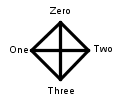
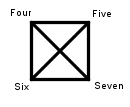
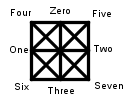
Notes on a musical pipe instrument are selected by covering or uncovering combinations of holes. The proposed notation for the notes of a pipe instrument displays the fingerings to be used to play the notes. Each of eight holes is represented in the proposed notation by a vertex. If the numbered hole is to be used in playing a note, then its representative vertex is to be joined by a line to the centre of the diagram for that note. The vertices for the covered holes by the same hand are joined to each other in the diagram for the note, but the vertices for holes played by different hands are not to be joined to each other except incidentally.

In the proposed notation, the vertices for the four holes played by the left hand are at the corners of a square oriented with its edges oblique like a diamond. The following picture diagram illustrates the notation for the left hand:

The vertices for the positions played by the right hand on the pipe are the corners of a square with its edges horizontal and vertical. Holes played by the right hand that are half covered can be indicated by writing a short line perpendicular to the diagonal of the square at the relevant vertex. The following diagram shows the notation for the right hand:

The notation for a single note combines both hands as shown in the following diagram:

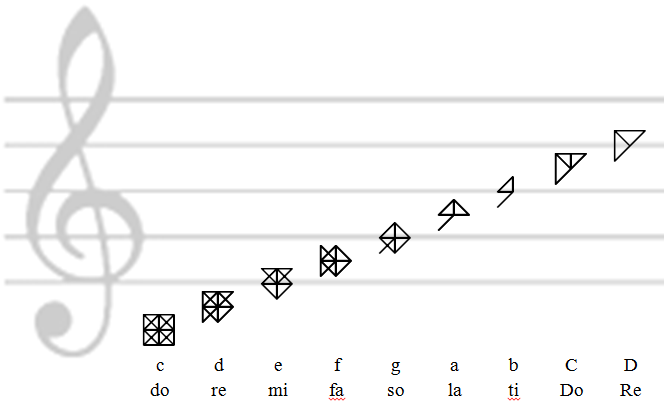
The fingerings for a selection of scale notes by this notation are exemplified on a treble stave in the following image:

There should be a ledger line for the note middle C. The diagrams for the notes can be written at least twice as big relative to the stave. It is possible to combine the note head diagrams with stems indicating note durations. A distinction between a filled, as of a crochet, or unfilled, as of a minim, note head could be achieved by a cartouche around the note head. Another way to specify the note durations is by writing a mathematical fraction immediately to the right of the diagrammatic note head. For example, a crotchet would be followed by the fraction 1/4. A dotted minim would be 3/4. Metric durations of tuplets can also be specified by this proposal.

The author of this article is the inventor of this proposed notation, is not reporting on the work of someone else, and has not seen anything like it elsewhere.

Base Twelve Calligraphic Numerals

Here is an image of rationally designed featural numerals for base twelve in a calligraphic pen style that was made yesterday well before six o’clock in the evening, based on principles worked out last year. It is possible to use versions of these numerals with a liquid crystal type of modular display containing twelve segments. There are references to Indo-Arabic numerals, Chinese numerals, and Roman numerals in these designs.

This is not a serious proposal for replacement of decimal numerals, for which a better distinguishable against decimal set more similar to the usual Indo-Arabic numerals and based on the normal seven segment modular display such as is used in pocket calculators was proposed earlier.